
Expanding your home is a great way to enhance its space, functionality, and value. Many homeowners explore options like extensions and orangeries to create additional living areas. However, before proceeding with any project, it is crucial to understand whether planning permission is required and if the build must comply with UK Building Regulations.
While our practice specializes in designing high-quality house extensions, remodeling projects, and inclusive adaptations, we do not design conservatories. Conservatories are typically provided by specialist manufacturers and installers who handle the entire process, from design to construction. If you are considering a conservatory, consulting a specialist conservatory company is recommended. However, for those looking to build an orangery or extension, understanding the legal and structural requirements is essential.
Planning Permission: Do You Need It?
Before beginning construction on an extension or orangery, it is important to determine whether planning permission is required. UK law states that any modification to a building or land requires planning approval, but certain home improvements fall under Permitted Development Rights and do not require formal permission.
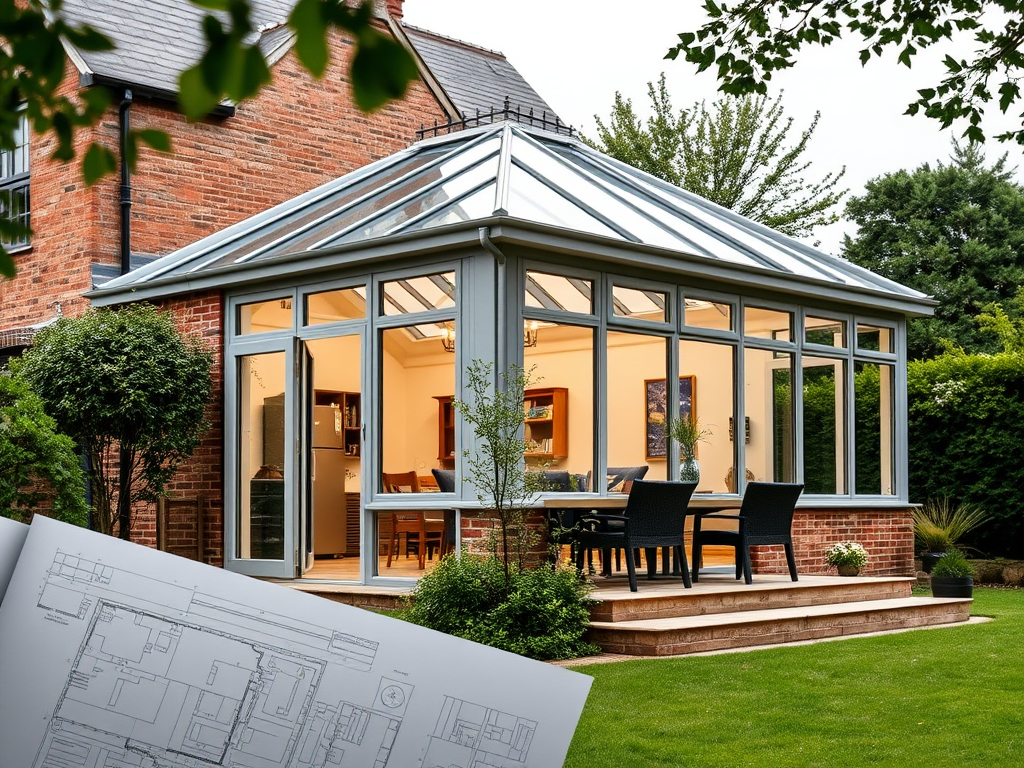
For homeowners considering an orangery, planning permission is not always necessary, provided the structure adheres to specific guidelines. An orangery can generally be built under Permitted Development if it does not exceed four meters in height, does not extend beyond four meters from the rear wall of a detached house or three meters for semi-detached or terraced homes, and does not cover more than fifty percent of the original garden space. It must also use materials that match the existing house. If an orangery is built with more solid walls than glazing or is directly connected to the home without an external door, it may be classified as an extension rather than an orangery and require full planning permission.
Extensions follow similar planning rules. If a single-storey rear extension extends beyond four meters for a detached home or three meters for other types of houses, full planning permission is needed. Two-storey extensions cannot exceed three meters in depth and must be at least seven meters away from the rear boundary. Side extensions must not be wider than half the width of the original house. If the property is located in a conservation area, National Park, or World Heritage Site, additional restrictions apply, such as prohibiting side extensions or changes to exterior finishes like cladding.
New-build properties often have specific restrictions set by developers, meaning planning permission may still be required even if the project meets Permitted Development criteria. It is always advisable to check with the local planning authority before beginning construction.
Consequences of Not Obtaining Planning Permission
Ignoring planning permission requirements can result in serious legal and financial consequences. If a structure is built without the necessary approvals, the local planning authority may issue an enforcement notice, requiring modifications or even complete removal of the build. Homeowners who fail to comply with these notices can face legal action, fines of up to £5,000, and even court proceedings.
Additionally, an extension or orangery built without the required permissions can cause issues when selling a property. Buyers and mortgage lenders often request proof that a structure complies with planning regulations, and non-compliant builds can lead to delays or complications in property sales. While retrospective planning permission can sometimes be granted, there is no guarantee, and some homeowners may have to make costly modifications to bring the structure in line with regulations.
Building Regulations: Ensuring Structural Compliance
Planning permission primarily concerns how a structure affects the surrounding area and its visual impact, while Building Regulations focus on safety, insulation, ventilation, and energy efficiency. Unlike planning permission, Building Regulations approval is always required for extensions and usually for orangeries, depending on their design and integration with the main house.
A project must meet modern standards for structure, insulation, electrical safety, fire resistance, and drainage. If an orangery is fully open to the main house without external doors separating it, or if it includes a solid roof or steel framework, it will need Building Regulations approval. Full compliance is required for any structure integrated into the existing home’s heating system or one that includes elements affecting the house’s structure.
A property owner who ignores Building Regulations risks enforcement action from the local authority, requiring changes or even demolition of the non-compliant structure. If work does not meet required safety standards, it can also lead to insurance issues and legal liabilities. Additionally, when selling the home, any work that does not comply with Building Regulations can prevent the sale from proceeding unless a regularization certificate is obtained, which can be a complex and costly process.
Planning Permission vs. Building Regulations: Understanding the Difference
Many homeowners confuse Planning Permission with Building Regulations approval, but these are two separate requirements. Planning permission is concerned with the impact of the build on the surrounding area, while Building Regulations focus on the structural integrity and safety of the build.
An orangery or extension may not need planning permission if it falls within Permitted Development guidelines, but it will need Building Regulations approval if it includes structural changes, heating integration, or significant insulation work. For homeowners considering these types of projects, it is important to plan carefully and seek professional advice to ensure all legal requirements are met.
Choosing the Right Option for Your Home
For those looking to add more space to their home, an extension is the most integrated and permanent solution but requires both Planning Permission (in most cases) and full Building Regulations approval. An orangery offers a balance between a conservatory and an extension, providing a bright and open space with better insulation than a conservatory. However, most orangeries still require Building Regulations approval, and depending on their design, they may also need planning permission.
A conservatory, on the other hand, is a lightweight glazed structure that is typically not subject to Building Regulations or Planning Permission if it meets Permitted Development criteria. Since conservatories are highly specialized, they are best designed and built by specialist companies that provide full installation and compliance services.
For homeowners considering an orangery or extension, seeking professional advice before starting construction is essential. Our practice specializes in designing house extensions, remodeling projects, and accessibility-focused designs, ensuring they meet all planning and building regulations. If you are considering a project that falls into these categories, we can help you navigate the legal requirements and design a high-quality extension tailored to your needs.
For conservatories, we recommend consulting a specialist conservatory provider who can guide you through the process from design to installation.
If you need guidance on designing and obtaining planning approval for an extension or orangery, feel free to get in touch for professional advice tailored to your property.
 Jbh Architectural Services
Leave a comment